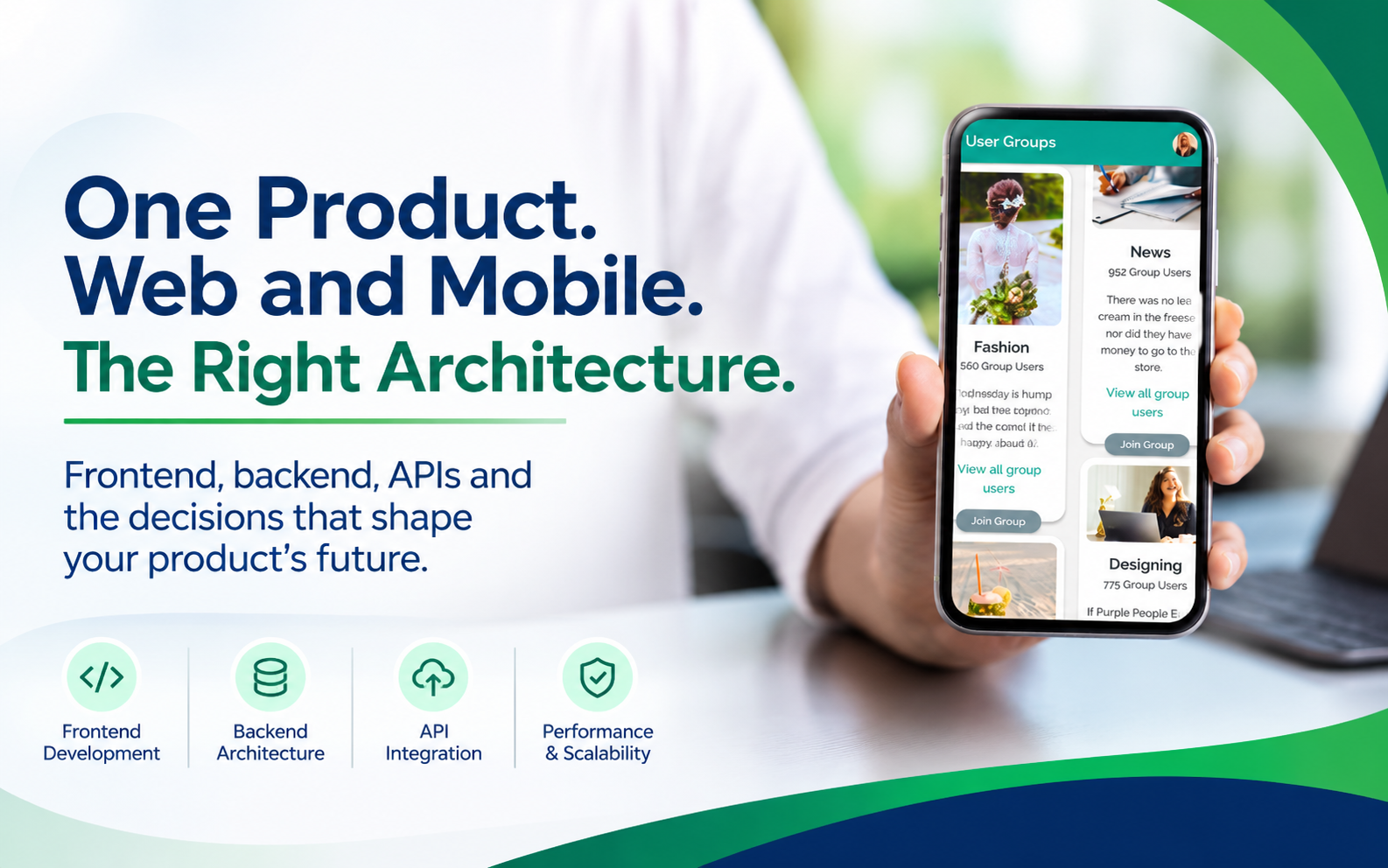
Building One Digital Product for Web and Mobile: How to Choose the Right Architecture
A digital product rarely exists on just one screen anymore. Customers may discover a service through a website, continue using it through a mobile application, and expect their information and activities to remain consistent across every device.
For businesses planning a new digital product, this creates an important architectural question: Should one technology be used for every platform, or should different technologies be selected for web and mobile?
The answer depends on the product, its users, technical requirements and long-term business goals.
At Aroasis Softech, we believe technology decisions should begin with understanding the product—not simply choosing a popular framework.
One Product Does Not Always Mean One Technology
Using a single framework across web, Android and iOS can offer advantages. It may allow greater code reuse, simplify certain development processes and create a more consistent technical environment.
However, each platform has its own expectations.
A web application needs to work across browsers, screen sizes and desktop environments. It may also require browser-based accessibility, search visibility and flexible navigation.
Mobile applications have different priorities. Touch interactions, device features, notifications, responsiveness and platform-specific user experiences can influence how they should be developed.
A framework that works well for one platform may not always be the most suitable choice for another.
The objective is not necessarily to use fewer technologies. It is to select technologies that serve the product effectively.
Single Framework vs. Multiple Frameworks
Both approaches have their place in modern application development.
A single-framework approach can be useful when:
- The product requires similar experiences across platforms.
- Code reuse is a major priority.
- The required features are supported consistently.
- The development team can maintain the solution efficiently.
A multiple-framework approach can be more suitable when:
- Web and mobile users have significantly different requirements.
- Platform-specific functionality is important.
- Performance and user experience need separate consideration.
- Different technologies offer better capabilities for different parts of the product.
However, using multiple frameworks also means managing separate codebases, updates, testing processes and release cycles.
There is no universally correct choice. The right architecture is the one that balances development efficiency, user experience, flexibility and maintenance.
The Backend: What Keeps Everything Connected?
Choosing frontend technologies is only one part of building a multi-platform application.
Consider a user who updates their profile through a mobile application and later accesses the same account through a website. They expect their information to remain consistent.
This requires a well-planned backend architecture.
A connected application generally involves four important layers:
- Frontend: The interface users interact with on web and mobile.
- Backend: The business logic, processing and application operations.
- Database: The storage and management of application information.
- APIs: The communication layer connecting different applications and services.
With a properly designed backend and API structure, multiple applications can access shared services and work with consistent data.
This also makes future integrations and feature expansion easier to manage.
What Should Businesses Consider Before Development?
A product may work perfectly during its initial launch but face new challenges as users, data and functionality increase.
That is why architectural planning should consider more than the first release.
- User experience: Will users need different features or navigation on web and mobile?
- Performance: Can each application deliver a responsive experience under expected workloads?
- Scalability: Can the backend, database and infrastructure support increasing users and activity?
- Security: Are authentication, access controls, data protection and secure communication properly planned?
- Maintenance: How will framework updates, bug fixes and application releases be managed?
- Testing: Can changes be tested across platforms without affecting existing functionality?
- Future expansion: Will the architecture support additional integrations, services or platforms?
These decisions can influence the product's development cost, maintenance effort and ability to evolve over time.
A Practical Example: Developing a Social Media Platform
The architecture question becomes particularly relevant when developing a social media product.
Such a platform may need to support user profiles, content sharing, interactions, messaging, notifications and other features across web and mobile applications.
The challenge is not simply making the same interface available on different devices. It is ensuring that users receive a consistent experience while each application works effectively within its platform.
For one of our social media development projects, Aroasis Softech worked on a Progressive Web App (PWA) alongside Flutter mobile applications for Android and iOS.
The solution was designed to support cross-platform access, social networking, professional networking, an e-commerce store and communication features.
The project demonstrates how different application technologies can work together as part of one connected digital product.
Explore the project: Revolutionizing Social Media: Building a Progressive Web App for Seamless Connectivity
Architecture Should Support the Product's Future
Application development does not end when a product goes live. New features, changing user expectations, integrations and increasing workloads all influence how the system needs to evolve.
A well-planned architecture makes it easier to manage these changes without unnecessarily rebuilding the entire product.
This is why technology selection should consider the complete development lifecycle—from planning and design to deployment, maintenance and future expansion.
The best architecture is not necessarily the one that uses the fewest technologies. It is the one where every component has a clear purpose and all the components work together to deliver a reliable, scalable product.
Building Connected Digital Experiences with Aroasis Softech
At Aroasis Softech, we approach web and mobile application development by understanding the business requirements, user journeys and technical challenges behind each project.
Whether a business needs a web application, Android or iOS app, or a complete multi-platform solution, the focus remains on selecting an appropriate technology stack and building a system designed for long-term use.
Planning a digital product? Connect with Aroasis Softech to discuss your requirements and explore the right development approach.
Website: https://www.aroasissoftech.com/
Continue the discussion: Read our related LinkedIn newsletter, One Technology for Everything? Rethinking the Architecture of Multi-Platform Applications.