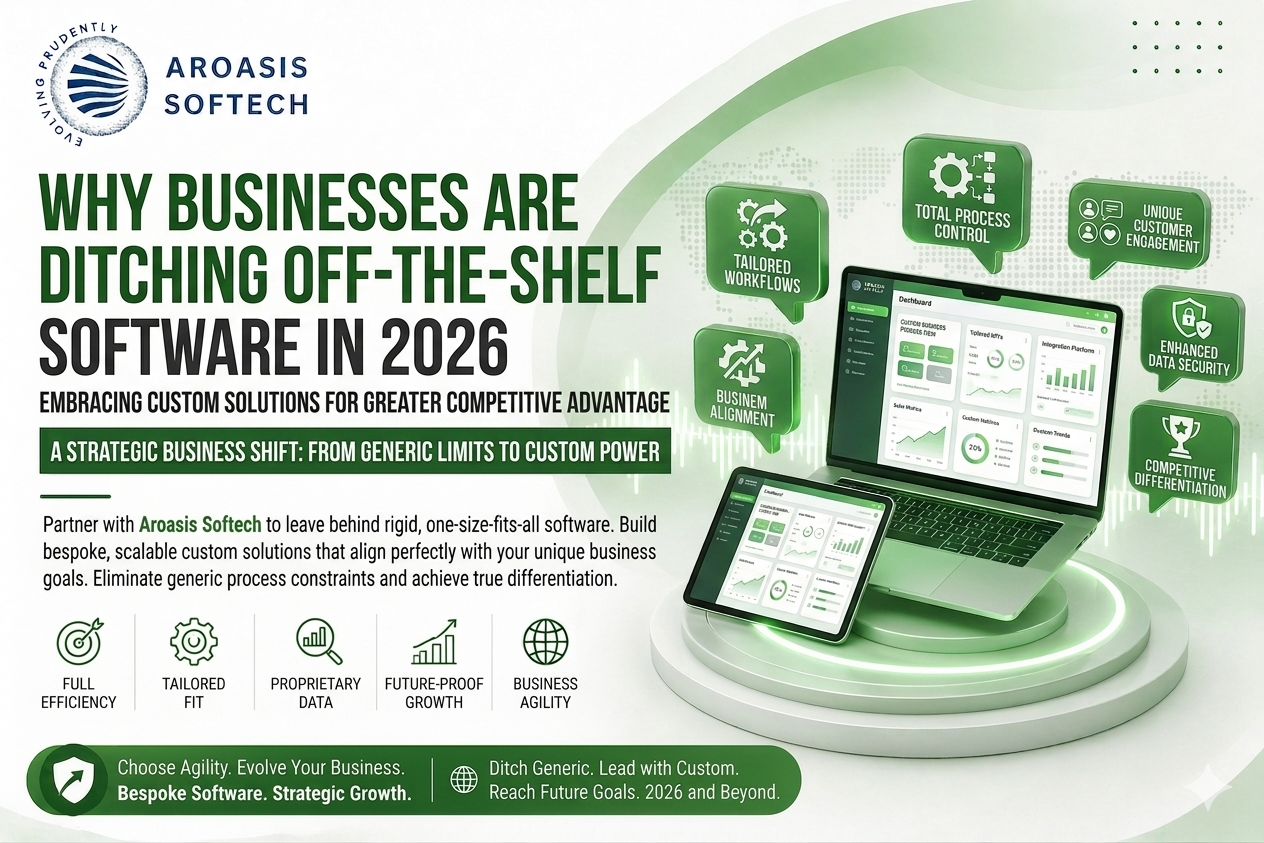
Why Businesses Are Ditching Off-the-Shelf Software for Custom Solutions in 2026
Most businesses don’t fail because of bad ideas—they fail because their tools can’t keep up.
In 2026, companies are scaling faster than ever. Customer expectations are rising, operations are becoming more complex, and digital systems are expected to work together seamlessly. However, many organizations still rely on off-the-shelf software that was never designed for their specific workflows.
That gap is becoming too expensive to ignore.
As a result, more businesses are shifting away from generic tools and adopting custom software solutions built around their exact operational needs.
The Problem With Off-the-Shelf Software
Off-the-shelf software is designed for the mass market. It works for general use cases, but it quickly shows limitations as businesses grow or differentiate.
- Limited flexibility in workflows
- Unnecessary features that add complexity
- Missing functionality for specific operations
- Integration issues with other tools
- Recurring subscription costs that increase over time
What starts as a “quick solution” often becomes a long-term operational constraint.
Why Businesses Are Making the Switch
1. Businesses Don’t Want to Adapt to Software Anymore
The biggest shift in 2026 is simple: businesses no longer want to change how they work just to fit software.
Instead, they expect software to adapt to them.
- Build workflows around real operations
- Eliminate unnecessary steps
- Improve speed and efficiency
- Align tools with business strategy
2. Scalability Has Become Critical
Many off-the-shelf tools work well at a small scale but break down as businesses grow.
Custom software is designed to scale from day one:
- Add new features without restrictions
- Handle more users and data
- Support expanding business models
- Adapt to evolving requirements
3. Integration Is No Longer Optional
Modern businesses rely on multiple systems—CRM, ERP, analytics tools, and payment systems.
Without integration, businesses lose time and accuracy.
- Connect all systems into one ecosystem
- Enable real-time data flow
- Reduce manual work and duplication
- Improve decision-making speed
4. Long-Term Cost Efficiency
Off-the-shelf tools may look cheaper initially, but costs increase over time through subscriptions, add-ons, and inefficiencies.
Custom software requires upfront investment but reduces long-term cost by:
- Eliminating multiple subscription tools
- Improving operational efficiency
- Reducing dependency on third-party platforms
5. Security and Control Matter More Than Ever
With rising cyber threats and compliance requirements, businesses want full control over their systems.
- Define custom security architecture
- Control user access levels
- Meet industry compliance standards
- Reduce exposure from shared platforms
Where Custom Software Is Being Used
- Workflow automation systems
- CRM and ERP platforms
- Inventory and supply chain systems
- Booking and scheduling platforms
- Customer and employee portals
- Data dashboards and analytics systems
The goal is simple: replace fragmented tools with unified systems that match real business operations.
The Real Shift
This transition is not just about technology—it is about control.
- Control over operations
- Control over data
- Control over user experience
- Control over future scalability
Off-the-shelf tools limit control. Custom software expands it.
Final Thoughts
In 2026, software is no longer just a support tool—it is a core business asset.
Companies relying on rigid, one-size-fits-all systems often face hidden limitations that slow down growth.
Meanwhile, businesses investing in custom software are building systems that evolve with them.
That is why this shift is happening now—and why it will continue accelerating in the years ahead.